News

What do we lose when we ignore traditional constructive wisdom?

sabedoria.webp
What do we lose when we ignore traditional constructive wisdom?

Architecture is an art of time: it is built with materials, but also with memory. For centuries — if not millennia — builders knew how to make use of local resources, climate, solar orientation, water, and wind. Vernacular solutions were not born of chance, but rather of empirical wisdom, developed by generations who observed, experimented, and passed on knowledge. Traditional architecture, in this sense, was deeply ecological, functional, and human.

However, with the advent of industrialization and modernism, and more recently with the dominance of minimalist aesthetics and normative standardization, much of this knowledge has been relegated to a decorative, folkloric, or supposedly “outdated” status. The result is not merely symbolic: the loss of these elements has practical consequences — thermal discomfort, premature degradation, excessive use of energy resources — as well as symbolic ones — the dehumanization of spaces, their disconnection from the landscape and from those who inhabit them.

Eaves: an intelligent protection forgotten

Let us begin with eaves. For centuries, extending the roof beyond the line of the walls was an almost universal gesture. In Trás-os-Montes, in Swiss villages or traditional Japanese houses, the eave protected from rain, intense solar radiation, and snow. By shading walls and openings, it reduced overheating in summer. By preventing water from running down the façade, it avoided infiltration, efflorescence, and early material degradation.

In contemporary architecture, the eave has disappeared. Roofs are often designed flush with the wall, with no overhang — often due to an obsession with the purity of lines. But what is gained in formal “cleanliness” is lost in performance: humidity pathologies emerge, dirty façades, walls exposed to summer sun, and greater dependence on mechanical systems to compensate for what could have been solved with a simple 60 cm overhang.

Proportions and the human scale

Another striking example is that of proportion. Until the 18th century, construction measurements were derived from the human body: the cubit (from elbow to fingertips), the fathom (arm span), the palm, the foot. Spaces and objects were intuitively scaled to human use. It was anthropometric architecture, even if unconsciously so.

With the arrival of the decimal metric system, officially adopted in Europe in the 19th century, everything began to be measured in metres, centimetres, and millimetres — an abstraction useful for industry and standardization, but disconnected from the body. Thus emerged compartments with 2.50 m ceilings by convention, not necessity, and stairs with arbitrary dimensions, designed by software rather than experience of use.

Today, many buildings feel “out of scale” or “inhospitable” without a clear reason why. Perhaps because they lost harmony with the body, with movement, with gesture. The beauty of many old buildings lies in their harmony — not just visual, but physical.

Thick walls and thermal inertia

In traditional construction, the thickness of walls — often in stone or rammed earth — was not only structural, but thermal. These walls functioned as batteries of heat and cool: in summer, they absorbed solar radiation, keeping the interior cool; in winter, they slowly released stored warmth. Today, with thin walls, artificial insulation, and forced air conditioning systems, this natural inertia is lost. Buildings become vulnerable to sudden temperature variations and rely on electricity to provide comfort that was once passive.

Deep windows and solar protection

Windows set into thick walls, with generous frames and sills, created transitional zones between exterior and interior. The natural shading these recesses offered protected from direct sunlight and enhanced privacy without blocking daylight. Today, window frames are often flush with façades, with glass glued directly to the outer surface, lacking any passive protection. The result: overheating, glare, and higher energy consumption.

Porches, transitions, and dwelling

Mediterranean houses — from Roman domus to Andalusian patios — articulated interior and exterior through transitional spaces: porches, balconies, galleries. These zones served for ventilation, shading, resting, and socializing. Today, compartmentalization is more rigid, and these transition zones disappear or become merely decorative, losing their thermal and social function.

Solar orientation and empirical knowledge

The orientation of façades, the placement of windows, and the distribution of interior spaces were traditionally defined based on observation of the sun, prevailing winds, and ground moisture. A house in Gerês would not be oriented like one in Alentejo. Today, many buildings are replicated in series, ignoring place, climate, or topography. “Site planning” has become a technical gesture, often decided in floor plans rather than as a response to the land.

A future that learns from the past

None of this implies rejecting technology or innovation. On the contrary: architecture must be capable of integrating current technical, energy, and regulatory requirements without losing its sense of place, proportion, climate, and human experience. The future of sustainable architecture does not lie in replicating old forms, but in relearning the principles that shaped them: passive protection, climate adaptation, relationship with human scale, intelligent use of materials.

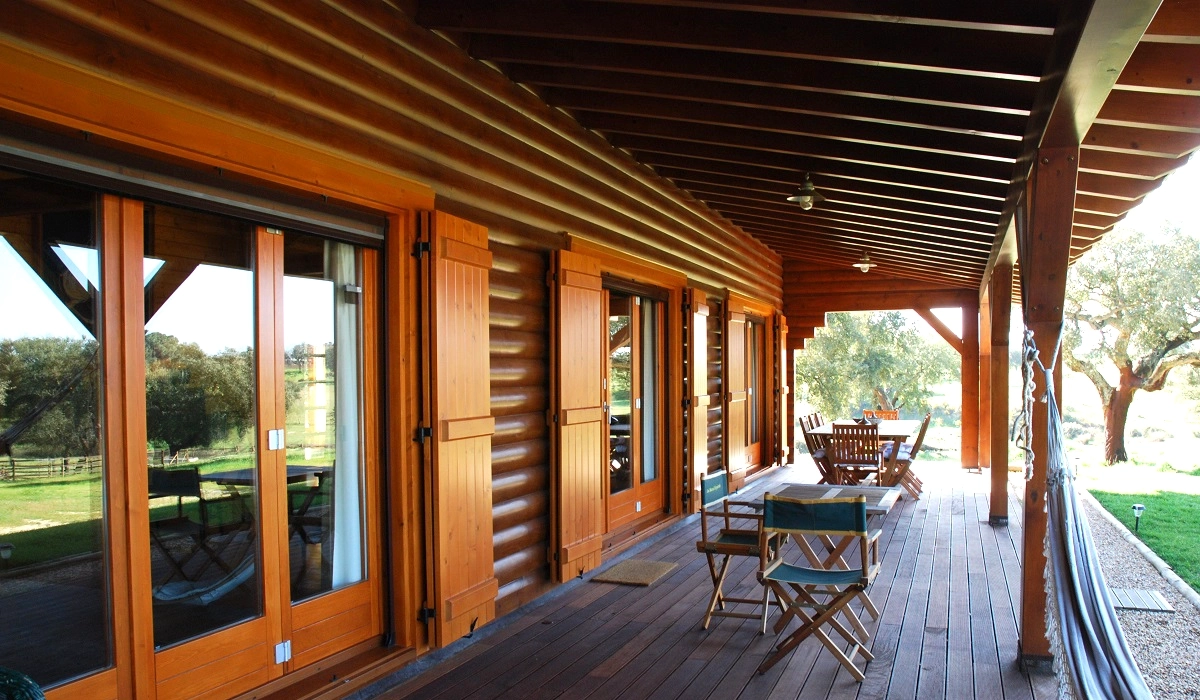
In this context, rusticasa® has been actively seeking to recover and apply this ancestral wisdom in its timber construction projects, combining contemporary technical solutions with building practices rooted in tradition. Whether through the use of projecting eaves, ventilated façades, porches, or careful solar orientation, the company works to raise awareness among its clients of the benefits of architecture that prioritizes thermal and visual comfort, even when that means moving away from the most common solutions in today’s market. This approach extends beyond construction itself and includes a pedagogical effort — based on dialogue and trust — that restores the sensibility and rootedness of the act of dwelling.

Recovering traditional constructive wisdom is not an act of nostalgia, but of intelligence. In a time of environmental and energy crisis, it is urgent to look at the past not as a museum, but as a repository of proven solutions — which contemporary architecture can and must reinterpret with creativity and rigour.

Related articles

Enor 2020 Architecture Awards

The jury of the 8th edition of the Enor Elevators 2020 Architecture Prize, formed by Carlos Seoane (president), Carlos Quintáns (secretary), Emilio Tuñón (Enor Grand Prize 2017)...

Read more

Wood in buildings, the future that Europe wants

On 16 September 2020, Ursula von der Leyen, President of the European Commission, delivered her 2020 State of the European Union address before the Members of the European Parliament...

Read more

rusticasa® inaugurates new showroom

rusticasa®, a recognised leader in the timber construction sector, celebrates a significant milestone with the inauguration of its latest show house, built using the Timber Frame system...

Read more