News

The use of timber in architecture and construction

wood-structures.webp
The use of timber in architecture and construction

Prof. Guglielmo Giordano

An influential figure in the field of research and teaching, Professor Guglielmo Giordano, a distinguished specialist in wood science and technology, Emeritus Professor at the University of Florence, who passed away in Florence on 4 February 2000 at the age of 95, was a deeply religious man, renowned for the depth of his thought and wisdom. This article reproduces his complete dissertation presented at the 1st Iberian Technical Seminar held in Porto in 1996.


Among natural raw materials, wood remains one of the fundamental materials that have shaped the development of human civilisation. Since prehistoric times, it has enabled early humans to feed, warm and shelter themselves, marking the beginnings of architectural thinking.

During the nomadic period, structures were created simply by gathering branches and poles, often covered with animal hides. The earliest forms, of a pyramidal type, quickly evolved into tents, offering a more suitable volume for daily life. When humans began cultivating the land and settling, these tents transformed into huts with vertical walls supporting pitched roofs, capable of draining rainwater effectively.

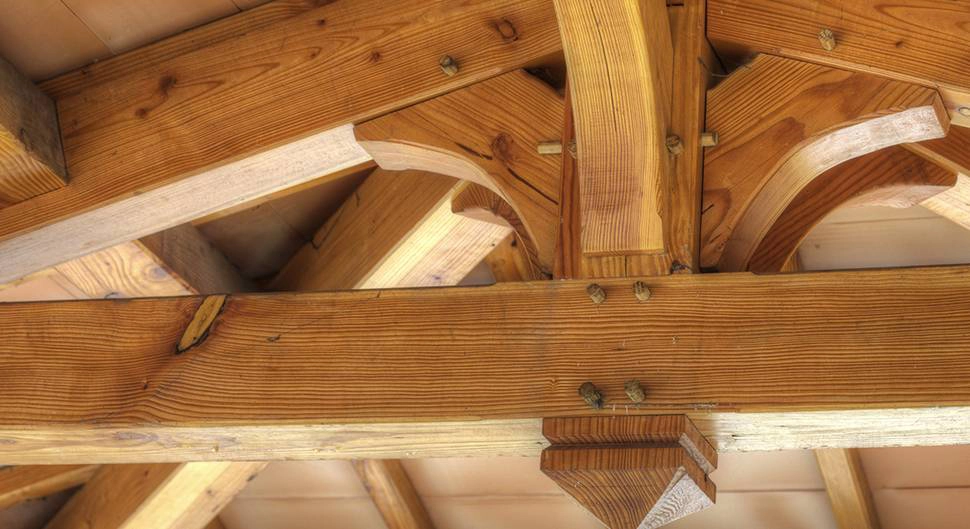
These formal advances led to the conception of a fundamental structural principle: the triangular truss, consisting of two rafters joined at the top and a horizontal tie beam connecting their bases. The addition of a central king post allowed a better distribution of forces, making the structure both stable and efficient.

This structure, resting on opposite walls, was simple yet robust. However, in regions rich in forests, the walls themselves were often made of timber through the superposition of logs carefully notched at the corners — a technique that gave rise to the log house typology.

From the prototype of the triangular truss — whose span rarely exceeded six metres — various reticular structures were developed, composed of assemblies of indeformable triangles that made it possible to achieve spans of 20 to 25 metres. These innovations paved the way for more daring architectural forms, where the straight line gave place to mixed extrados curves.

The constructive traditions of the Far East offer a striking contrast to those of medieval Europe. In Japan and China, multi-pitched concave roofs rest on a series of columns of varying height, supporting a complex network of beams and carved capitals. These systems, based on refined empirical logic, gave rise to technical manuals for temple carpenters, reflecting a millennia-old mastery of timber craftsmanship.

In Europe, the rise of urban building gradually led to the use of stone, brick, and mortar. Nevertheless, timber remained ubiquitous: in roofs, floors, ceilings, stairs, doors, windows, and decorative elements. In Central Europe, the art of timber framing achieved a delicate balance between resistance and aesthetics, requiring highly skilled craftsmanship.

However, wood presented certain limitations: its naturally rectilinear form and the limited size of trees posed challenges for large-span construction. To overcome these constraints, master carpenters invented a variety of ingenious joints and assemblies, many of which have survived to this day.

The 16th century marked a crucial turning point with Philibert De L’Orme (1566), who replaced the traditional triangular truss with a timber arch composed of several layers of planks joined together. This innovation eliminated the need for the conventional triangular elements (tie beam and king post) while enabling the use of smaller timber sections, preserving larger logs, which were becoming scarce.

The Renaissance and Baroque periods, from the 15th to the 17th centuries, profoundly transformed the art of building. De L’Orme’s invention, combined with improved joinery techniques, allowed builders to overcome the shortage of large timbers, a scarcity aggravated by naval demands and population growth. By the late 18th century, the rise of foundries and the demand for charcoal led to a temporary decline in timber use for construction.

In the 19th century, the advent of steel and reinforced concrete seemed to relegate timber to a secondary role. However, the technological progress of the 20th century — notably the development of synthetic resin adhesives — marked a true renaissance for the material.

The advent of gluing techniques and the development of glued-laminated timber (glulam) revolutionised structural timber design. By bonding under pressure thin, carefully calibrated lamellae, it became possible to create large-span structural members of varied geometry, using small-dimensioned wood. The introduction of finger joints enabled the production of elements spanning dozens of metres.

Taking advantage of wood’s inherent elasticity and formability, curved members could be produced using specific formwork, making it possible to cover large spaces such as riding halls, swimming pools, gymnasiums, and cinemas. This flexibility gave rise to a new architectural aesthetic, combining structural performance with expressive form.

The use of vaults and laminated shell structures illustrates these advances. Barrel or conoid vaults are formed by juxtaposing boards between two arches, while shells rely on three-dimensional geometry: the straight lines connecting the sides of a quadrilateral define a paraboloid that can rest on just three supports. Rigidity is ensured by cross-laminating two or three layers of timber.

Such structures can cover areas of up to 600 m², and their modular repetition allows the creation of extensive complexes. Their use is particularly suitable for churches, schools, exhibition halls, and multipurpose buildings, where natural light and structural lightness are desirable.

Timber domes, whether ribbed or reticular, represent the culmination of this evolution. The former employ curved laminated ribs converging toward a central oculus, while the latter adopt triangular meshes inspired by geodesic metal structures. These systems demand remarkable precision, especially in the design of metal joints at structural nodes.

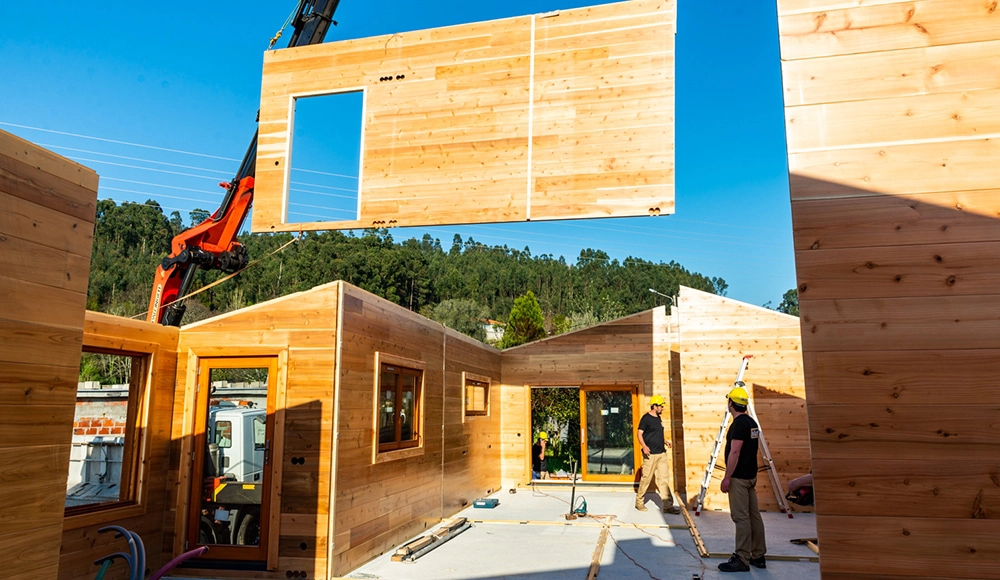
Finally, the second half of the 20th century witnessed the growth of prefabrication, which industrialised the use of solid wood and its derivatives in panel form. Although sometimes regarded as a “less noble” form of architecture, it nonetheless represents a valuable contribution to solving contemporary housing problems, combining rationality, material economy, and environmental respect.

As former Inspector General of the Italian Forest Service, I wish to emphasise that the development of prefabrication — particularly in tourist villages and weekend houses — must not become a pretext for irresponsible forestry practices such as clear-cutting or the covert thinning of forest edges. Sustainable forest management remains essential to the continuation of this long construction tradition.

Human beings have an essential need to maintain contact with nature. At the end of a working day, they should be able to rest their eyes and minds upon the changing colours of the natural world — not upon a dismal accumulation of concrete blocks.

Guglielmo Giordano

Related articles

rusticasa® receives Prestige Diploma

Marking the passage of the Hundredth Thirtieth Anniversary (1892-2022) of the Construction and Public Works Industrialists Association, AICCOPN awarded rusticasa® with the Prestige...

Read more

AIT-Award 2020

Casa do Rio is a finalist for AIT-Award 2020 | Best in Interior and Architecture, in the “Hotel” category. The result will be known on 11 March at the award ceremony in Frankfurt. In the...

Read more

éco Maison Bois

This month, the French magazine éco Maison Bois, specialized in the wood construction sector, published in its issue 54 two articles on achievements of rusticasa® and our subsidiary in...

Read more