Fire behaviour of solid and glued laminated timber structures: technical and regulatory analysis
This article analyses the fire behaviour of solid timber and glued laminated timber (glulam) structures, highlighting the main thermochemical mechanisms involved, the formation of the charred layer, the loss of load-bearing cross-section and the residual load-bearing capacity. Through a review of the scientific literature and current European regulations (in particular, Eurocode 5 – Part 1-2), the implications for structural design are discussed and the performance of timber is compared with other construction materials under fire conditions. Experimental data on the performance of timber elements in standardised fire resistance tests are also presented. It is concluded that, despite being combustible, solid and glued laminated timber offers a predictable fire response, making it suitable for structural applications in buildings with high safety requirements.
Keywords: structural timber, fire resistance, glulam, charring, Eurocode 5, resilient structures.
Introduction
Timber has been widely used in civil construction throughout history and has returned in recent decades as a premium material for sustainable and low-impact building solutions (Frangi & Fontana, 2005). In particular, solid timber and glued laminated timber (glulam) structures have been adopted in medium and high-rise buildings, requiring a rigorous analysis of their fire behaviour. Contrary to the common perception of fragility in fire, timber exhibits unique performance characteristics when exposed to high temperatures, which can be effectively exploited in structural design.
Thermal mechanisms and timber degradation
Exposure of timber to heat triggers a pyrolysis process that begins at temperatures between 200 and 300 °C, leading to the thermal decomposition of cellulose, hemicellulose and lignin (White & Dietenberger, 2010). This decomposition generates combustible gases that feed the flame, leading to the progressive formation of a charred layer on the surface of the timber. This layer plays a crucial role in controlling thermal propagation, as it has low conductivity and acts as an insulating barrier (Frangi et al., 2008).
Regulatory approach and design methods
The European standard EN 1995-1-2 (CEN, 2004), part of Eurocode 5, defines two main methods for designing timber structures in fire situations: the reduced cross-section method (simplified) and the thermo-mechanical method (advanced). Both are based on estimating the charring depth over time, with charring rates ranging from 0.6 to 0.8 mm/min for most species used in Central Europe (Östman et al., 2010).
The simplified method considers the progressive loss of structural cross-section and allows verification of the residual load-bearing capacity over time. The advanced method, on the other hand, includes integrated thermal and mechanical models, particularly applicable to complex structures or those subjected to non-uniform actions.
Experimental performance of solid timber and glulam
Tests on solid timber and glulam elements have shown high predictability in the progression of charring and the retention of load-bearing capacity. Frangi and Fontana (2005) observed that glulam beams with 180 mm height, exposed to standard fire (ISO 834), maintained structural stability for more than 60 minutes, even without additional protection.
Further studies (Schmid, König & Frangi, 2011) found that the addition of fire-resistant claddings, such as gypsum boards, can delay the onset of charring and significantly improve the resistance (R) rating of structural elements.
Comparison with other materials
By comparison, steel loses mechanical strength rapidly above 400–500 °C, requiring passive protection to ensure stability (EN 1993-1-2, 2005). Concrete, although non-combustible, can suffer from explosive spalling at high temperatures. Timber, on the other hand, provides a predictable fire response and retains part of its structural capacity even after several minutes of exposure.
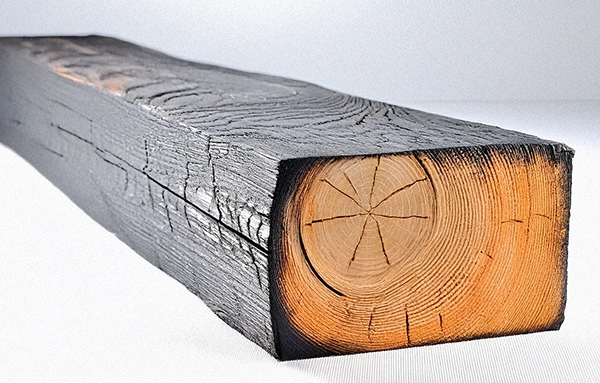
The surface charring of timber creates a protective layer against fire, due to its lower thermal conductivity compared to uncharred timber.
|
|
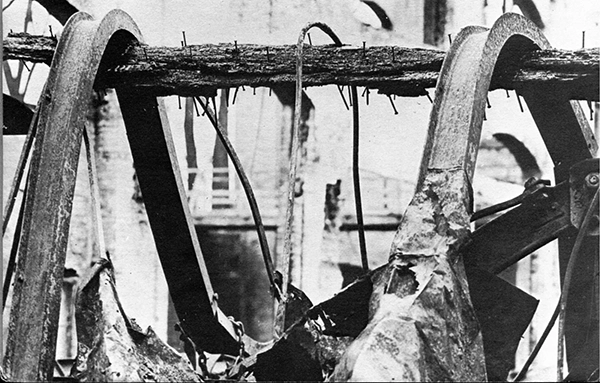
Failure of steel beams after fire, supported by a charred timber beam with sufficient residual strength to carry the load of the structure.
|
Discussion
The main advantage of structural timber in terms of fire safety lies in the formation of the charred layer and the ability to maintain the integrity of the unaffected section. Timber elements with high thermal inertia, such as solid columns or large glulam beams, can achieve fire resistance ratings of R60 or R90 relatively easily, without the need for passive protection (Frangi et al., 2008).
Proper design, consideration of charring rate, and application of Eurocode 5 rules allow timber structures to be designed with safety levels equivalent to traditional materials, supporting their growing adoption in contemporary architecture.
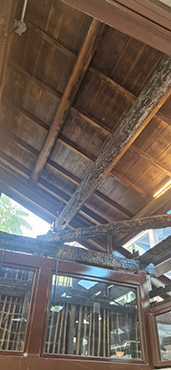
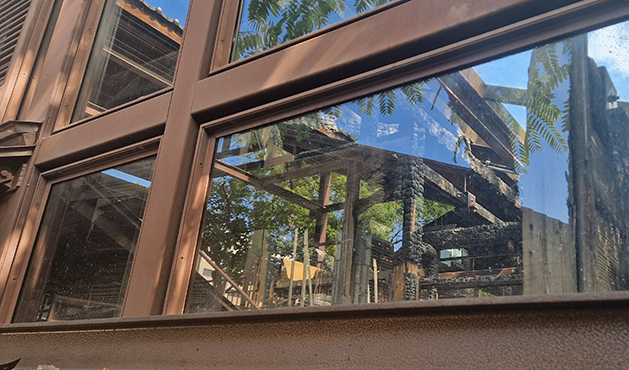
The residences of the officers of the former Taipei Prison, built during the period of Japanese occupation in the 1910s, stand as a testament to the institutional architecture of the time. Preserved and rehabilitated, these buildings retain traces of their past, revealing the condition in which they were found prior to the restoration process and affirming the intention to value their constructive history.
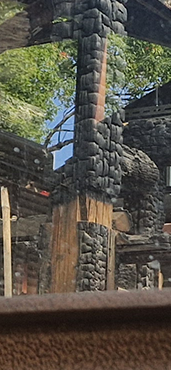
Among these traces, the presence of the marks left by a previous fire stands out, integrated as part of the building’s narrative. The carbonization of the wood allows observation of its structural stability and, in a specific area, the removal of this layer reveals the wood in its original state, perfectly preserved. This material contrast highlights the resilience of wood as a structural element in the face of the action of fire.
|
Conclusions
Solid and glued laminated timber offer robust and reliable fire structural performance, provided that the regulatory design criteria and good construction practices are applied. Their ability to withstand fire, combined with sustainability, lightness, and ease of assembly, makes timber a competitive material for buildings with high structural requirements. The consolidation of technical knowledge on timber fire behaviour has contributed to its growing recognition in structural engineering.
References
- CEN. (2004). EN 1995-1-2: Eurocode 5 – Design of timber structures – Part 1-2: General – Structural fire design. European Committee for Standardization.
- CEN. (2005). EN 1993-1-2: Eurocode 3 – Design of steel structures – Part 1-2: General rules – Structural fire design. European Committee for Standardization.
- Frangi, A., & Fontana, M. (2005). Fire performance of timber structures under standard and natural fire. In Proceedings of the International Workshop “Structures in Fire” (pp. 299–310). Ottawa, Canada.
- Frangi, A., Fontana, M., Knobloch, M., & Mischler, A. (2008). Fire behaviour of glued laminated timber elements. Fire Safety Journal, 44(8), 1078–1085.
- Östman, B., Brandon, D., & Frangi, A. (2010). Fire Safety in Timber Buildings – Technical guideline. SP Report 2010:19. SP Technical Research Institute of Sweden.
- Schmid, J., König, J., & Frangi, A. (2011). Design model for load-bearing timber elements in fires. Structural Engineering International, 21(1), 29–36.
- White, R. H., & Dietenberger, M. A. (2010). Fire Safety of Wood Construction. In Wood handbook: Wood as an engineering material (Chapter 18). USDA Forest Service, Forest Products Laboratory.